
The Hidden Cost of Homeownership: How Utility Bills Impact Affordability in Tiffin and Fremont
When people think about buying a home, they usually focus on the purchase price and the mortgage payment. But for many homeowners in Tiffin and Fremont, utility costs have become one of the biggest — and most overlooked — factors affecting monthly affordability.
Electric, natural gas, water, sewer, and trash services are all essential, but rising costs mean they now take up a larger share of household budgets than they did just a few years ago. For both homeowners and small businesses, these costs can quietly limit financial flexibility and long-term planning.
What Utilities Typically Cost Locally
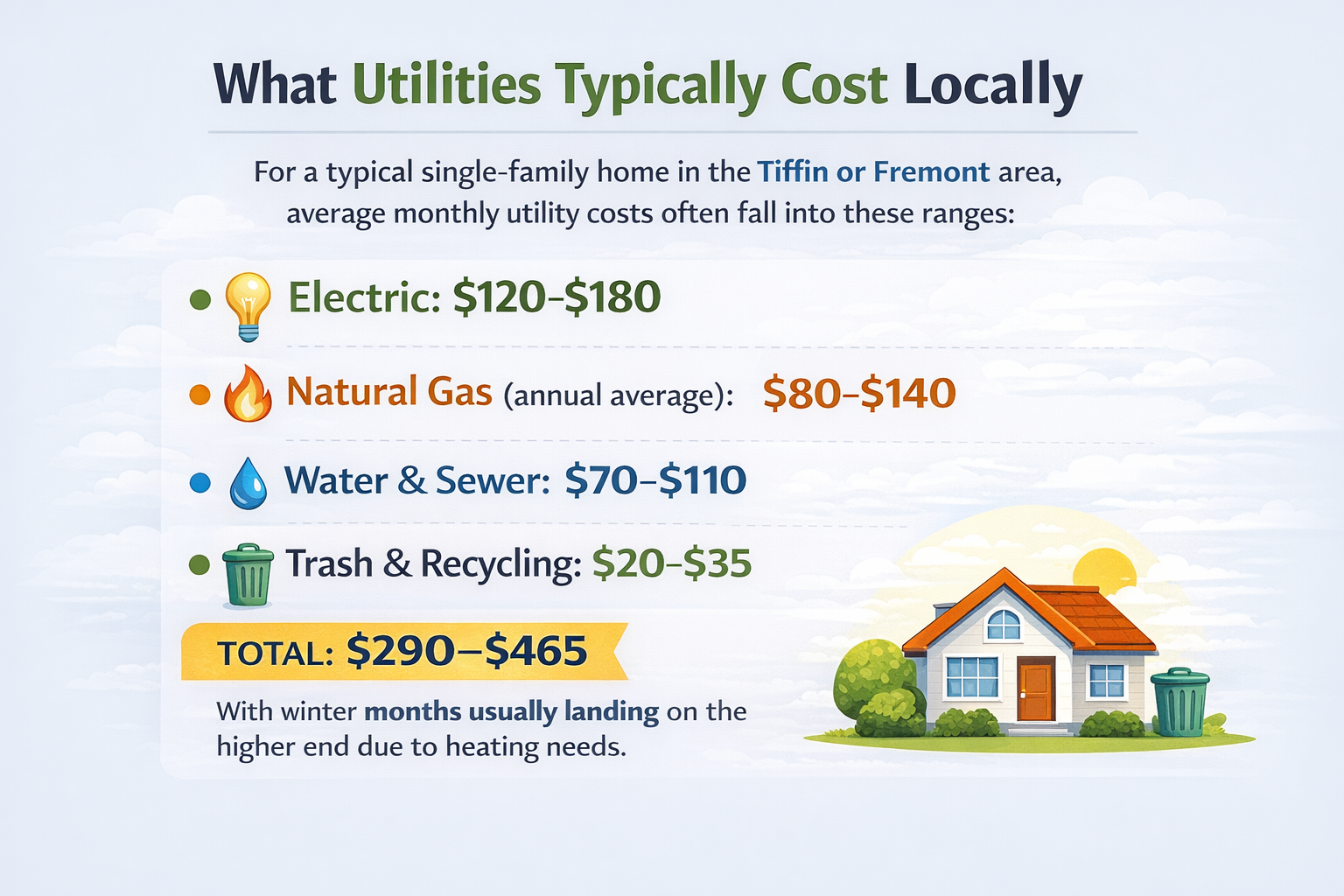
For a typical single-family home in the Tiffin or Fremont area, average monthly utility costs often fall into these ranges:
-
Electric: $120–$180
-
Natural Gas (annual average): $80–$140
-
Water & Sewer: $70–$110
-
Trash & Recycling: $20–$35
That puts total monthly utilities between $290 and $465, with winter months usually landing on the higher end due to heating needs.
For businesses, costs can be even higher depending on building size, operating hours, and equipment use — which is why utilities are increasingly being factored into lease and expansion decisions.
Why Utility Costs Matter More Than Ever
Utility bills are considered fixed monthly expenses, just like a mortgage or car payment. When fixed costs rise, something else has to give.
For homeowners, that often means:
-
Less room in the budget for repairs or upgrades
-
Delaying renovations or energy improvements
-
Feeling “house-poor” even with a reasonable mortgage payment
For buyers, the impact is even more direct.
Utilities vs. Buying Power: The Real Connection
Here’s where utilities directly affect affordability:
An additional $150 per month in utility costs equals $1,800 per year.
Mortgage lenders factor recurring expenses into overall affordability, which means that extra cost can reduce what a buyer can comfortably afford.
A simple rule of thumb:
Every $150/month in added fixed costs can reduce buying power by $25,000–$35,000.
That difference alone can:
-
Move a buyer from a newer home to an older one
-
Eliminate certain neighborhoods from consideration
-
Reduce options for space, garages, or acreage
Simple Affordability Calculator (How to Use It)
Use a calculator to estimate how higher utility costs affect purchasing power.
Example:
-
Extra utilities per month: $150
-
Annual cost: $150 × 12 = $1,800
-
Divide by 30% (a common affordability guideline)
That equals $6,000 per year in income impact, which often translates to tens of thousands of dollars less in home price range once lending ratios are applied.
This is why two homes with the same price can feel very different financially.
What Buyers and Homeowners Can Do
Because utilities matter more now, buyers are paying closer attention to:
-
Age and efficiency of furnaces and AC systems
-
Window quality and insulation
-
Utility history from sellers
-
Energy-efficient upgrades and smart thermostats
For homeowners, energy improvements aren’t just about comfort — they can also protect resale value by keeping future monthly costs predictable.
The Bottom Line
In communities like Tiffin and Fremont, affordability isn’t just about price — it’s about monthly reality. Utility costs have become a meaningful part of that equation, shaping buying decisions, home values, and long-term financial comfort.
Understanding these costs upfront helps buyers make smarter choices and helps homeowners plan ahead in a changing cost environment.
For more information: Call Damian Wise at 720-600-1960 or EMAIL
Categories
Recent Posts

GET MORE INFORMATION

Agent License ID: DWISE